Stay-at-Home Mom Resume: Examples and a Step-by-Step Guide for Returning to Work
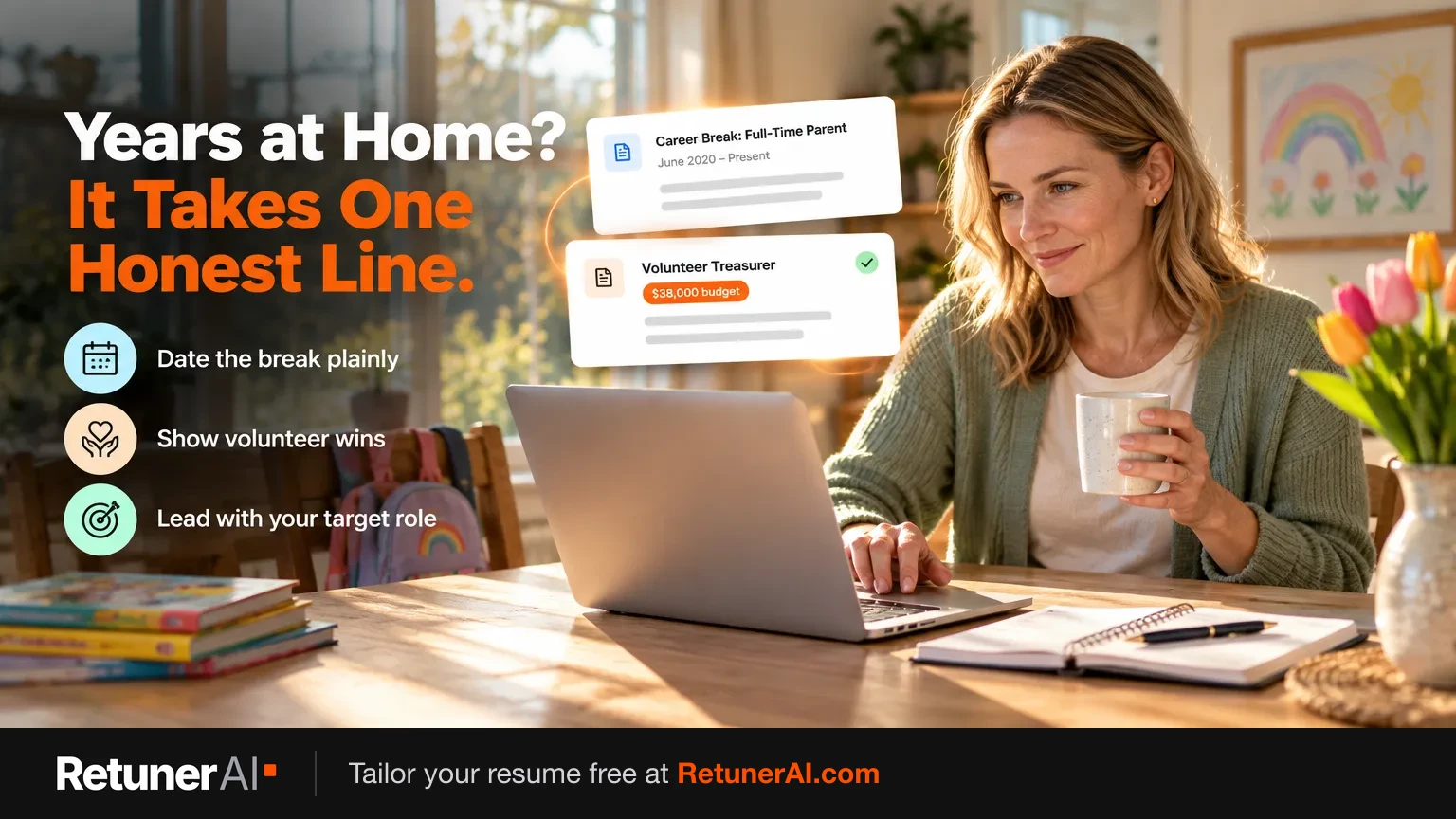
You’ve been home with your kids for two years, or eight, and now you’re looking at a blank resume and wondering what to do with that stretch of time. The good news is that the time at home is the easy part. It takes one honest line. The harder part is building the rest of the resume so it shows what you can do for an employer now.
Quick answer: On a stay-at-home mom resume, list your time at home as one dated entry in your experience section, such as “Career Break: Full-Time Parent, June 2020 – Present,” with a one-line description. Put anything relevant you did during that time (volunteer roles, freelance or part-time work, courses) in separate entries with specific bullets. Use a chronological or hybrid format rather than a purely functional one, open with a summary that names the job you’re returning to, and keep only skills that are current. RetunerAI’s free Resume Builder lets you fill all of this in on one of three ATS-friendly templates and download a PDF; you only need a free account.
Stay-at-home mom resume example
Here is a complete example for a mom returning to office work after about six years at home. Dana is fictional and every detail is illustrative, but the structure is the one this article recommends: a summary that explains the return, a single honest line for the break, relevant volunteer work in its own section, and earlier jobs with concrete results.
Dana Whitfield
Columbus, OH | (555) 010-0142 | dana.whitfield@example.com | linkedin.com/in/danawhitfield
Summary
Operations coordinator with nearly six years of experience running scheduling, billing support and vendor relationships for a busy dental practice, returning to full-time work after a planned career break to raise two children. Kept organizational and financial skills current as volunteer treasurer of a 300-family school parent organization and completed QuickBooks Online and Excel training in 2026. Looking for an office manager or operations coordinator role.
Skills
- Scheduling and calendar management
- Vendor and supplier coordination
- Budgeting and account reconciliation
- QuickBooks Online
- Microsoft Excel
- Google Workspace
- Insurance verification
- Customer service
- Event and volunteer coordination
Experience
Career Break: Full-Time Parent
June 2020 – Present
Columbus, OH
Planned break to care for two young children. Available for full-time work.
Operations Coordinator, Brightview Family Dental
March 2017 – May 2020
Columbus, OH
- Managed daily schedules for four dentists and six hygienists, filling same-day cancellations from a waitlist
- Coordinated orders with eight supply vendors and cut duplicate orders by setting up a shared inventory sheet
- Handled insurance verification and billing questions for patients, escalating disputed claims to the billing manager
- Trained three new front-desk hires on the scheduling system and check-in process
Front Desk Coordinator, Brightview Family Dental
August 2014 – February 2017
Columbus, OH
- Checked in patients, answered phones and booked appointments for a two-location practice
- Reconciled daily payments and prepared end-of-day deposit reports
Volunteer Experience
Treasurer, Lincoln Elementary Parent-Teacher Organization
August 2022 – June 2025
Columbus, OH
- Managed a $38,000 annual budget, reconciled the account monthly and presented financial reports at board meetings
- Moved payment tracking from paper forms to a shared spreadsheet, so committee chairs could check balances themselves
Fundraising Chair, Lincoln Elementary Parent-Teacher Organization
2023 – 2024
Columbus, OH
- Organized the spring fundraiser with a 25-person volunteer team, coordinating vendors, schedules and day-of logistics
Education and Training
B.S., Business Administration, Ohio University
QuickBooks Online training course, 2026
Microsoft Excel intermediate course, 2026
Notice what the example does not do. It doesn’t hide the six years, apologize for them, or stretch them into a fake job. The break gets one line, and the space goes to evidence that matters for an office manager role: the earlier jobs and the treasurer work.
If you would rather fill in sections like these than wrestle with formatting in a word processor, a builder with ready-made templates saves you the layout work.
How to put stay-at-home mom on a resume
You have three reasonable options, and the right one depends on how long you were home and what you did during that time.
1. A dated career break entry (best for most people). Add one entry to your experience section, in date order with your jobs: a plain title, the months and years, and optionally one line of context. This is what the example above uses. It answers the question a reader will have about the dates before they have to ask it.
2. A career break entry with relevant bullets. If something you did at home connects directly to the job you want, such as running a household budget for a bookkeeping role, or coordinating schedules and vendors for an office role, you can add two or three bullets under the entry. Keep them specific and modest. If you also did volunteer, freelance or part-time work, those usually deserve their own entries instead, because they come with an organization, a role and results a reader can check.
3. A short break with no entry. If you were home for a few months between jobs, you can usually leave it off and mention it in a cover letter if you want to. For a longer break, a visible line often reads more clearly than leaving an unexplained gap.
For the job title, keep it plain: “Full-Time Parent,” “Stay-at-Home Parent” or “Career Break: Full-Time Parent.” Playful titles like “Domestic CEO” or “Chief Household Officer” are tempting, but they make the entry harder to read at a glance and can come across as overselling.
Sample stay-at-home mom job description for a resume
Here is a version you can adapt. Use only the bullets that are true for you and that relate to the role you’re applying for.
Career Break: Full-Time Parent | June 2019 – Present
Left the workforce to care for three children; now returning to full-time work.
- Managed a household budget of about $6,000 a month, including bill payment, savings goals and annual insurance renewals
- Coordinated schedules, appointments and transport for three children across two schools and four activities
- Researched and compared contractors for a kitchen renovation, negotiated quotes and kept the project within budget
A few rules keep this section credible. Use real numbers only if you know them. Don’t present parenting duties as professional credentials (“childcare specialist,” “logistics manager”). And if a bullet would be a stretch for the job you’re targeting, cut it; one honest line beats five padded ones.
LinkedIn also lets you add a Career Break to your profile, and full-time parenting is one of the break types you can choose. If you use it, keep the dates and wording consistent with your resume.
For more on wording a gap of any kind, including caregiving, our resume gap guide has examples you can borrow.
Resume for a stay-at-home mom returning to work: step by step
-
Pick the job you’re aiming for. A resume aimed at “anything” is hard to write and hard to read. Choose one type of role, such as office manager, medical receptionist, marketing coordinator or teacher’s aide, and look at three or four real postings for it. Note the skills and tools they keep asking for.
-
Choose your format. For most returning parents with earlier work history, a chronological or hybrid format is the right call. More on that below.
-
Write a summary that names the return. Two or three sentences: who you were professionally, that you’re returning after a career break, what you’ve done to stay current, and the role you want. The example’s summary is a template you can follow.
-
List your previous jobs with results, not duties. Your old roles are your strongest evidence. For each one, write three to five bullets about what you achieved or improved, with numbers where you have them.
-
Add the career break line. One dated entry, placed in date order. You don’t need to explain why you stayed home beyond “to care for my children” or similar.
-
Give relevant activity from the break its own entries. Volunteer roles, PTA or PTO positions, freelance projects, part-time or seasonal work, and courses or certifications all count. List them like jobs, with a title, an organization, dates and specific bullets.
-
Refresh your skills section. List skills and software you can use today. If a tool has changed a lot since you last used it, take a short course or practice before you list it.
-
Keep the format simple and the length reasonable. One page is usually enough for a returning parent; two is fine if you have a long career before the break. Clean headings and a standard layout keep the resume readable for both applicant tracking systems and the person reading it. Our ATS-friendly resume guide covers the formatting details.
You can do all of this in a word processor. RetunerAI’s free Resume Builder is a faster route if you want the layout handled for you: you pick one of three ATS-friendly templates, fill in sections for contact details, summary, skills, experience, education and certifications, and add custom sections such as Volunteer Work or Projects for the things you did during your break. You can rename the Experience heading too, and download the finished resume as a PDF. It needs a free RetunerAI account, with no paid plan required.
Stay-at-home mom resume with no work experience
If you went from school straight into full-time parenting, or your last job was so long ago that it’s no longer relevant, the resume has to be built from other material. That’s normal, and there’s usually more of it than you think.
Look for:
- Volunteer roles: PTA or PTO positions, school or library volunteering, faith community or sports-league roles, food bank shifts, nonprofit committees.
- Informal or freelance paid work: bookkeeping for a relative’s business, babysitting or tutoring, selling crafts online, event planning for friends who paid you.
- Education and training: a degree, even an unfinished one, plus recent online courses and certifications related to the job you want.
- Projects: organizing a school fundraiser, running a neighborhood group, managing a renovation.
Structure the resume this way: a summary that names the target role, a skills section, then your strongest entries (volunteer or freelance work usually comes first), then education and training. Write bullets the same way you would for a paid job: what you did, for whom, and what changed because of it.
One caution. Don’t call volunteer roles “employment” or invent job titles. A resume full of real volunteer and training entries reads as honest effort; a resume that dresses them up reads as something to probe in an interview.
If you’re returning to work in a different field from your old one, the career change resume guide goes deeper on transferable skills.
Functional vs. chronological resume for a stay-at-home mom
This is the format question most returning parents ask, and the short answer is that a pure functional resume usually causes more problems than it solves.
| Format | How it’s organized | Works well when | Drawback for returning parents |
|---|---|---|---|
| Chronological | Jobs listed newest first, with dates | You have a solid work history before the break | The break is the first thing in your experience section (one honest line handles this) |
| Functional | Skill groups at the top; jobs and dates minimized or left out | Rarely the best choice | Hiding dates can make the reader wonder what’s missing, which draws attention to the gap |
| Hybrid (combination) | Short skills section first, then a dated work history | You want to lead with skills and still show dates | Slightly longer; needs a tight skills section |
Chronological is the default most readers expect, and it’s the right choice if your earlier jobs are relevant to the role you want. The break appears as one dated line at the top of your experience section, and your previous jobs follow.
Functional resumes are often recommended for stay-at-home moms because they seem to hide the gap. In practice, a resume organized around skill headings with no clear timeline can look like it’s hiding something, and the reader still wants to know where and when you used those skills. A functional resume for a stay-at-home mom is worth considering only if your work history is very thin, and even then a hybrid usually does the same job better.
Hybrid gives you the best of both: a short skills section near the top, built from the skills the target job asks for, followed by a normal dated history including your career break. The example in this article is a hybrid.
Once you have a base resume
Your stay-at-home mom resume is a base document. When you start applying, each posting will emphasize slightly different things, and it helps to adjust your summary, skills order and bullets to match each job you apply to, without adding anything that isn’t true. The resume tailoring guide explains how to do it by hand.
If you’d rather not rewrite it for every application, RetunerAI’s AI resume tailoring does that step for you: upload your resume, add the job description, and get a complete tailored version in about 10 seconds that you review and edit before downloading. It’s designed to work from your actual experience rather than stuffing in keywords. It includes an unlimited 7-day free trial, so you can tailor your resume for several real applications before deciding whether to continue with a paid subscription.
FAQ
How do I put stay-at-home mom on my resume? List it as one dated entry in your experience section, with a plain title such as “Career Break: Full-Time Parent” and the months and years it covers. Add a one-line description if you like. Put anything you did during that time that’s relevant to the job you want, such as volunteer roles, freelance or part-time work and courses, in their own entries rather than inside the parenting line.
Should a stay-at-home mom use a functional resume? Usually not. A functional resume groups skills at the top and pushes dates to the bottom or leaves them out, which can make the reader wonder what’s missing. A chronological or hybrid (combination) resume shows the break openly, and the hybrid version still lets you open with a short skills section.
What job title should I use for my time as a stay-at-home mom? Use a plain, accurate title such as “Full-Time Parent”, “Stay-at-Home Parent” or “Career Break: Full-Time Parent”. Skip playful titles like “Domestic CEO” or “Chief Household Officer”; they make the entry harder to read at a glance.
What if I have no work experience at all? Build the resume around what you do have: volunteer roles, school or community leadership, freelance or informal paid work, education, courses and certifications. Lead with a short summary that names the job you want, then a skills section, then those entries with specific, honest bullets.
Can I build a stay-at-home mom resume with RetunerAI for free? Yes. RetunerAI’s Resume Builder is free with a free RetunerAI account; no paid plan is required. You choose one of three ATS-friendly templates, fill in your contact details, summary, skills, experience, education and certifications, add custom sections such as Volunteer Work or Projects, and download the resume as a PDF. Once you have that base resume, RetunerAI’s AI resume tailoring can adapt it to a specific job description in about 10 seconds, and it includes an unlimited 7-day free trial before you decide whether to continue with a paid subscription.
Ready to tailor your resume for a real job?
Turn your base resume into a job-specific ATS-ready version in about 10 seconds.
- · Match your resume to the actual job description
- · Generate a polished ATS-ready PDF
- · Review and edit before you apply
Tailor my resume free
"I finally got an offer after using it." — from a user email
More Career Resources
Tailored Resume Example: One Resume, Three Job Posts, Three Versions
A worked tailored resume example: one illustrative marketing resume rewritten for three different job posts, with every change shown and nothing invented.
The Complete AI Resume Tailoring Guide
Complete guide to AI resume tailoring, ATS optimization, resume formatting, career changes, resume gaps, and how to tailor your resume for any job description.
Resume Gap: How to Explain It and Still Get the Interview (2026 Guide)
Have a gap in your resume? Learn exactly how to explain any employment gap — layoff, caregiving, health, or personal — with real examples that work in 2026.