Does Google Have an ATS Score? What People Actually Mean
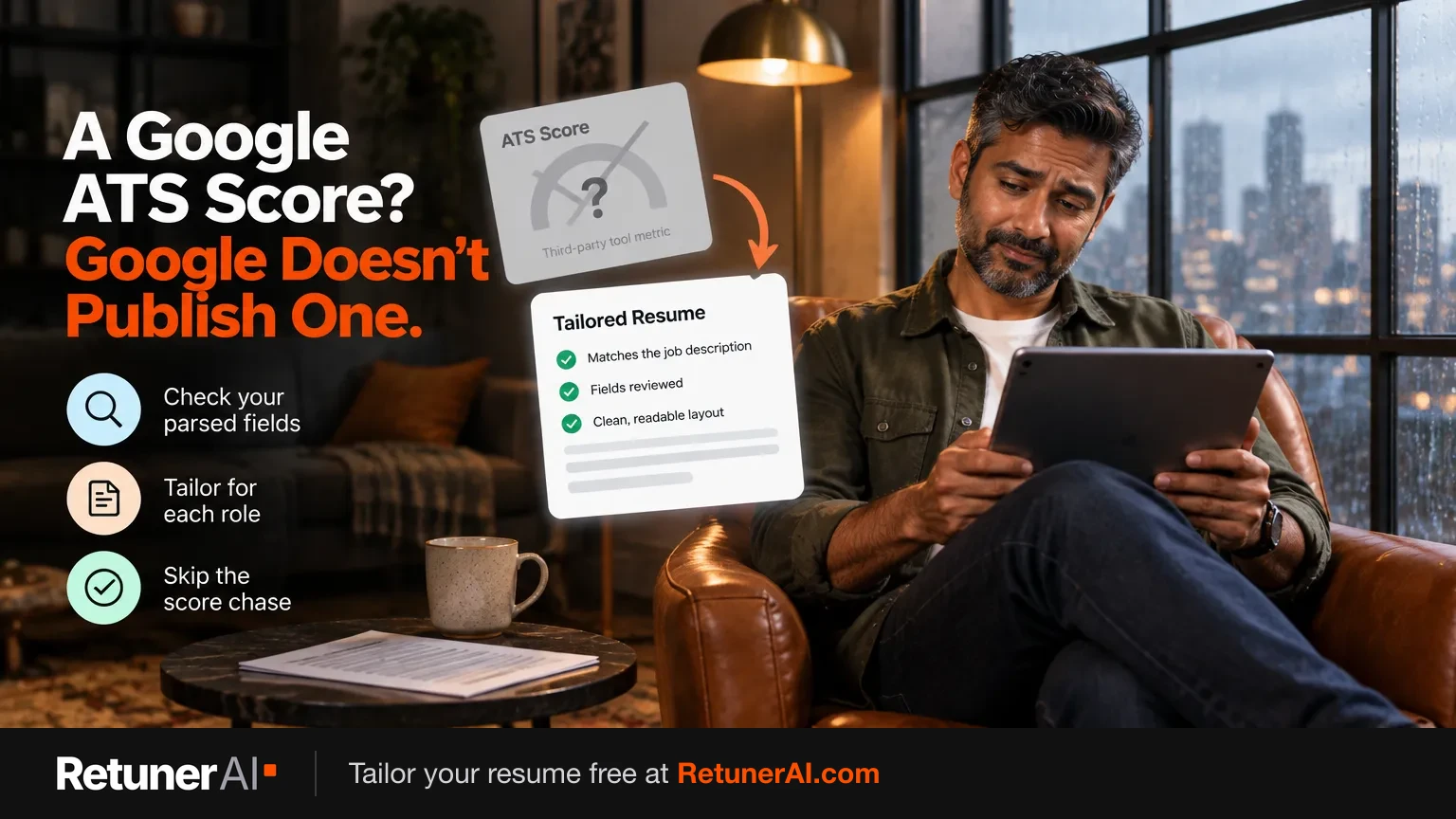
If you’ve seen a tool promise to “check your Google ATS score,” it’s reasonable to wonder whether Google really grades your resume with a number. This article separates three things that usually get blended together: what Google itself documents, what’s claimed about Google online, and what third-party score tools say about their own scores. Every Google statement below was checked on Google’s own pages in October 2026. RetunerAI is not affiliated with Google and has no inside knowledge of Google’s hiring systems.
Quick answer: Google doesn’t publish an ATS score for applicants. Google’s hiring-process page, its Careers Help page on applying, and its Applicant and Candidate Privacy Policy don’t mention any applicant-facing score, and Google doesn’t document how (or whether) its systems score resumes. What Google does document is a resume parser that can miss data, and specific advice to write a resume for each job. A “Google ATS score” you see online almost always comes from a third-party checker or an AI chat, and it measures whatever that tool decided to measure. The more useful target is the resume you actually submit. RetunerAI helps with that part: upload your resume and a job description and get a complete tailored version in about 10 seconds to review and edit, with an unlimited 7-day free trial.
What Google actually documents about its application system
Here is what Google states publicly about how applications to Google work, as of October 2026:
- You apply through a Careers Profile. Google’s Careers Help page says the Careers Profile “is a central place for you to add your information, upload your resume, and is required to apply to jobs at Google.” Resumes must not be over 2 MB, and you can upload from Google Drive or, on a desktop computer, from your own files.
- Google uses a resume parser, and says it isn’t perfect. The same help page says: “Sometimes our resume parser may not get complete or fully accurate data.” Google recommends filling in missing fields manually and double-checking that the fields “fully represent your previous experience.”
- Google says it reviews resumes for fit. On its hiring-process page, Google says: “We’ll review your resume/CV — and transcript for interns and new graduates — to determine the best fit.” It doesn’t describe the mechanics of that review.
- The only named test is a workstyle assessment, later in the process. Google says that before interviews “you may be asked to take the Google Hiring Assessment, designed to measure workstyle skills,” and possibly a role-related assessment such as a coding exercise. That’s an assessment you take, not a score of your resume.
- Google’s privacy policy talks about assessment, not scores. The Applicant and Candidate Privacy Policy lists “Assessing your skills, qualifications and interests against our career opportunities” among the ways applicant information is used. It doesn’t describe a numeric resume score.
What Google doesn’t publish matters just as much. None of these pages mention an ATS score, a keyword match rate, a ranking threshold or an automatic cutoff. That doesn’t prove Google uses no internal tooling; it means nothing public describes one. So any specific claim you read about how Google’s system scores, ranks or rejects resumes is not coming from Google’s published guidance.
Four things people mean by “Google ATS score”
The phrase gets used for at least four different things. Only one of them involves Google’s hiring, and that’s the one Google doesn’t document.
1. A score inside Google’s own hiring system
This is what most people picture: a number Google’s applicant tracking system assigns to your resume when you apply for a Google job. As covered above, Google doesn’t publish any such score, show one to applicants, or explain how one would work. Articles that describe Google’s ATS “scoring and ranking” candidates generally don’t cite a Google source for it, because Google’s hiring pages don’t say it.
2. Hire by Google, a discontinued product
Google did once have an applicant tracking product: Hire by Google, which it offered to other employers. Google’s farewell page states that “Hire by Google was sunset on September 1, 2020.” If you find an older article about “Google’s ATS” for businesses, it’s likely about this product, and it no longer exists.
3. Third-party ATS checkers, including ones in Google’s app stores
Search for “ATS score” and you’ll find checker apps and extensions listed in the Chrome Web Store, Google Play and Google Workspace Marketplace. Being listed in a Google store doesn’t make them Google products: the ones we found come from third-party developers. For example, one Chrome extension called ATS Resume Checker lists a third-party developer and describes its output as an “ATS compatibility score.”
Each of these tools defines its own checks: keyword overlap with a job description, formatting, section headings, length, and so on. That’s why the same resume can get different numbers in different tools. The score tells you how your resume did against that tool’s checklist. It isn’t a score from Google’s hiring system or from any employer’s ATS.
4. Asking Gemini or Google Search
Some people mean asking Google’s AI directly. Gemini can analyze an uploaded file (Google’s Gemini help page says Gemini Apps “support most file types”), so you can upload a resume and ask it to rate the resume against a job. If it gives you a number, that number was generated in your conversation based on your prompt. It isn’t a published Google hiring score.
Google Search’s job listings are a different thing again. Google’s Search help page tells you to choose a job site under “Apply,” and it doesn’t describe any resume scoring.
Documented facts vs. internet claims vs. tool claims
| Claim | Where it comes from | Status |
|---|---|---|
| Google uses a resume parser that may miss data | Google Careers Help, “Apply for a job” | Documented by Google |
| Google reviews your resume/CV to determine the best fit | Google’s hiring-process page | Documented by Google |
| Google asks for a resume written for each job | Google’s hiring-process page | Documented by Google |
| Google assigns your resume an ATS score | Third-party blogs and tool marketing | Not documented by Google |
| Google’s ATS rejects resumes below a match threshold | Third-party blogs | Not documented by Google |
| ”Your Google ATS score is 78%“ | A third-party checker or AI chat | That tool’s own metric |
| Hire by Google is Google’s ATS | Older articles | Discontinued September 1, 2020 |
Are third-party ATS scores worthless, then?
No. A checker can be a useful diagnostic. It can flag a section your file doesn’t parse cleanly, a heading the tool doesn’t recognize, or an important skill from the job description that’s missing from your resume even though you have it.
The problem is treating the number as the goal. A score inside a resume tool belongs to that tool’s evaluation system. Pushing it from 70 to 90 by repeating phrases from the posting can produce a resume that reads worse to the recruiter or hiring manager who eventually opens it, and Google doesn’t publish any target number you could aim for anyway. The thing a hiring team actually reads is your resume. If you want a deeper look at how proprietary match scores differ from employer ATS behavior, our Jobscan alternatives guide covers that distinction.
What to focus on instead when you apply to Google
Since there’s no published score to optimize, focus on what Google does tell you:
- Write a resume for the specific role. Google says to “start with a blank document and create a resume specifically designed for each job you want,” align your experience with the job description, and make sure your resume “clearly demonstrates alignment” with the role’s minimum qualifications. Our guide on how to get hired at Google walks through Google’s full resume and interview guidance.
- Check what the parser pulled out. Because Google says its parser may not capture everything, review the fields in your Careers Profile after uploading and fill in anything missing or wrong before you submit.
- Keep the file clean and under 2 MB. A simple, readable layout is easier for any parser and any person. Our ATS-friendly resume guide covers formatting that tends to parse reliably.
- Use the posting’s language only where it’s true. Matching the posting’s terms for skills you genuinely have makes the alignment obvious. Adding skills you don’t have to raise a checker’s number doesn’t help you in an interview. For the step-by-step process, see how to tailor a resume to a job description.
The same approach works for other employers. Their ATS setups vary, and very few publish how they evaluate resumes, so a well-tailored, readable resume is the part you can actually control.
Where RetunerAI fits
To be direct about what RetunerAI is not: it doesn’t produce a Google ATS score, it isn’t affiliated with Google, and it can’t tell you how Google’s systems evaluate an application, because Google doesn’t publicly document that.
What RetunerAI does is the part Google actually asks for: a resume tailored to each job. You upload your existing resume, paste the job description (from Google or any other employer), choose one of three ATS-friendly templates, and RetunerAI generates a complete tailored resume in about 10 seconds. It’s designed to produce natural, professional, job-specific writing based on your actual experience rather than blind keyword stuffing, and if a skill isn’t supported by your background, RetunerAI shouldn’t invent it.
When it’s finished, you have a resume, not a score and a list of homework. You review it, edit anything you want, and download it. If you want a cover letter (Google says it doesn’t require one), RetunerAI’s Cover Letter Generator uses the same resume and job description to produce a complete, job-specific letter in about 10 seconds.
RetunerAI includes an unlimited 7-day free trial, so you can tailor resumes for several real applications, at Google and elsewhere, before deciding whether to continue with a paid subscription.
FAQ
Does Google give applicants an ATS score? Not publicly. Google’s hiring-process page, its Careers Help page on applying, and its Applicant and Candidate Privacy Policy (all checked October 2026) don’t describe any ATS score or resume score that applicants can see. Google says it will review your resume/CV to determine the best fit, but it doesn’t publish a score or how one would be calculated.
Is there an official Google ATS score checker? No official one that Google documents. The ATS score checkers we found listed in the Chrome Web Store, Google Play and Google Workspace Marketplace (October 2026) come from third-party developers, not Google. The score each one shows is that tool’s own measurement, not a score from Google’s hiring system or from any employer.
What was Hire by Google? Hire by Google was an applicant tracking product Google offered to other employers. Google’s own farewell page says it was sunset on September 1, 2020, so any current tool calling itself a Google ATS is not that product.
Does Google use a resume parser? Yes. Google’s Careers Help page says, “Sometimes our resume parser may not get complete or fully accurate data,” and recommends filling in missing fields manually and checking that they accurately represent your experience. Google doesn’t publish anything about scoring the parsed data.
Does RetunerAI give me a Google ATS score? No. RetunerAI is an AI resume-tailoring tool and is not affiliated with Google. Instead of a score, it gives you a complete tailored resume: upload your resume and a specific job description, and RetunerAI generates a job-specific version in about 10 seconds, based on your actual experience, that you review and edit before downloading. RetunerAI includes an unlimited 7-day free trial, so you can tailor resumes for several real applications before deciding whether to continue with a paid subscription.
Ready to tailor your resume for a real job?
Turn your base resume into a job-specific ATS-ready version in about 10 seconds.
- · Match your resume to the actual job description
- · Generate a polished ATS-ready PDF
- · Review and edit before you apply
Tailor my resume free
"I finally got an offer after using it." — from a user email
More Career Resources
How to Get Hired at Google: What Actually Helps
What Google's own careers site tells candidates about resumes, choosing roles, assessments and interviews, and how to tailor your resume to each Google posting.
Resume for Apple: How to Tailor It
How to tailor your resume to a specific Apple job posting: reading Minimum vs. Preferred Qualifications, matching your real experience, and what jobs.apple.com accepts.
Resume Not Getting Interviews? A 15-Minute Diagnostic
Applying and hearing nothing back? Work through this five-point check to find the actual reason your resume isn't landing interviews, then fix it.