How to Get Hired at Google: What Actually Helps
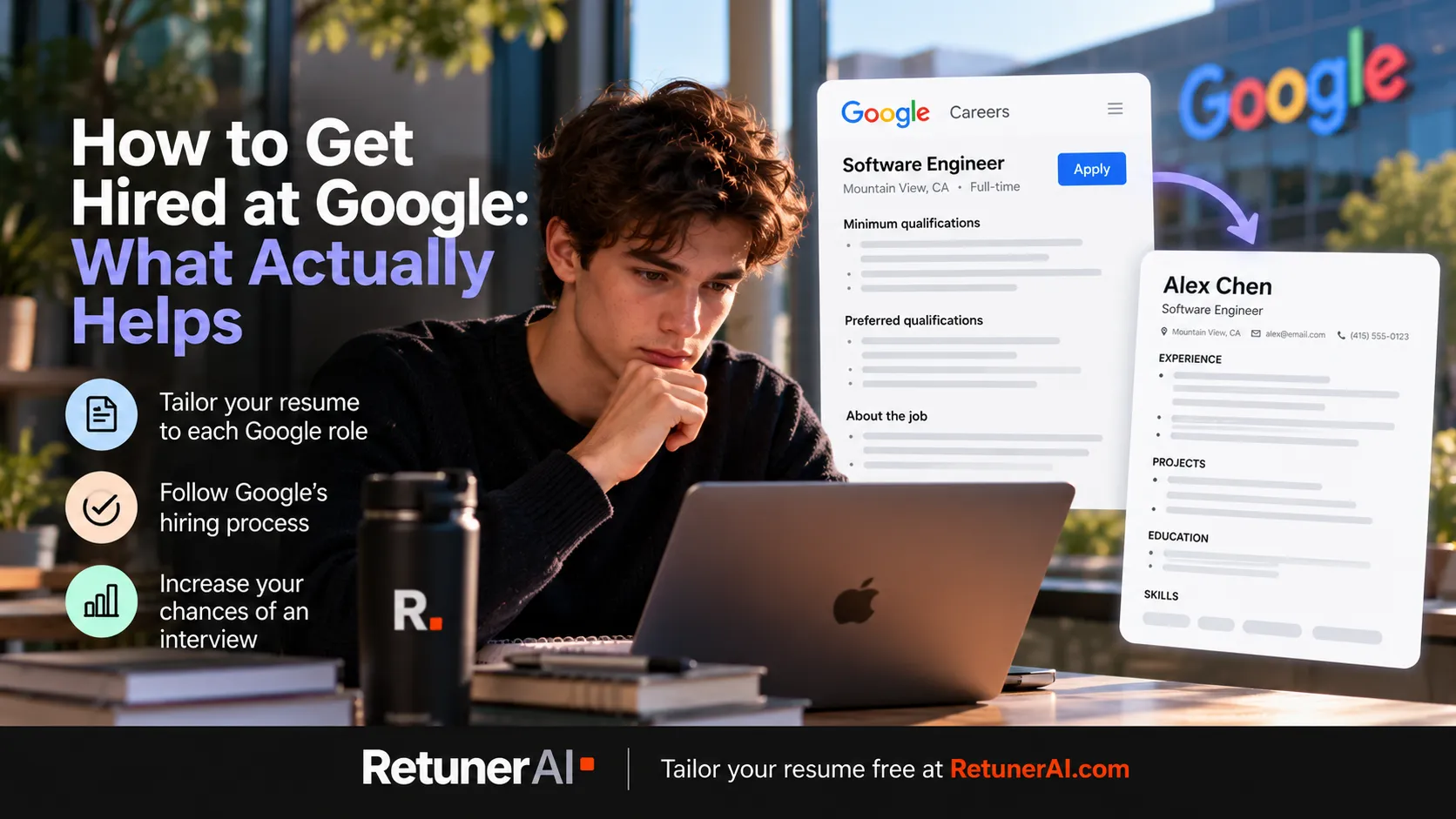
Most “how to get a job at Google” advice mixes two things: what Google actually tells candidates, and claims nobody can source. This guide sticks to the first. Everything below about Google’s process comes from Google’s own careers site and live Google job postings, checked in October 2026. RetunerAI is not affiliated with Google, and nothing here is insider knowledge or a guarantee of an interview or offer.
Quick answer: Google publishes fairly specific guidance. Build a separate resume for each Google job you apply to, make sure it clearly shows the role’s minimum qualifications, and describe results with Google’s suggested formula: “accomplished [X] as measured by [Y], by doing [Z].” Because Google limits you to three applications in a rolling 30-day window, choose roles you genuinely match. If you’re selected, expect a process that typically takes roughly 6 to 8 weeks, with possible assessments, recruiter conversations, project work for some roles, and structured interviews with no brainteasers. RetunerAI makes the job-specific resume part faster: upload your resume and a Google job description and get a complete tailored version in about 10 seconds to review and edit, with an unlimited 7-day free trial.
What Google says it wants on your resume
Google’s hiring-process page calls the resume “our first look into your past experiences and impact,” and its advice is direct: keep your old resume nearby for inspiration, but “start with a blank document and create a resume specifically designed for each job you want.”
For each position, Google lists what that job-specific resume should do:
- Align your experience with the job description. Tie your work directly to the role’s qualifications, and include data.
- Show the minimum qualifications clearly. Google asks you to make sure you meet the role’s minimum qualifications (it calls them MQs) and that your resume “clearly demonstrates alignment” with them.
- Be specific about outcomes. What was the result of the project, and how did you measure success? Google’s suggested formula is “accomplished [X] as measured by [Y], by doing [Z].”
- Describe leadership with scope. If you’ve led people, say how big the team was and what the scope of your work was.
- Use school work if you’re early in your career. Recent graduates and people with limited work experience are told to include school projects or coursework that show relevant skills.
- Keep it short. Google says it has no length requirement, but being clear and succinct is key.
On cover letters, Google is unusually explicit: it doesn’t require them and suggests putting that time into the resume instead. If you do write one, the same rules apply: tailor it to the job, show how you’ve made a difference, and use data.
Read the Google posting before you write anything
The Google postings we checked on Google’s careers site (a software engineering role and two marketing roles) all use the same structure: Minimum qualifications, Preferred qualifications, About the job and Responsibilities. All three listed “Bachelor’s degree or equivalent practical experience” as a minimum qualification.
The two qualification lists do different jobs:
Minimum qualifications are the baseline. On the early-career software engineering posting, one of them reads “1 year of experience with software development using C++ and Python.” On a Google Classroom product marketing posting, they include “6 years of experience in a product marketing role or marketing communications role” and “Experience in EdTech or education-focused SaaS platforms.” If you meet a minimum qualification, it shouldn’t take any hunting to find it on your resume. Use the posting’s own terms where they truthfully describe your experience, and put that evidence where it’s easy to find.
Preferred qualifications are where real extra evidence goes. The same engineering posting prefers “Experience with compilers or toolchains” and “Knowledge of LLVM.” If you’ve actually done that work, make it visible with a specific result. If you haven’t, leave it out. A preferred qualification is not a checklist item to claim.
Also read the small print. That engineering posting, for example, asked applicants to submit their resume in English. Notes like this vary by role and location, so check each posting rather than assuming.
Choose your three applications carefully
Google’s careers site says you can apply for up to three jobs within a rolling 30-day window. Google recommends narrowing your choices to roles that truly match your skills, experience and interests “versus applying to anything and everything that resembles your ideal job.”
In practice, that cap changes the strategy. Mass-applying isn’t an option, so each application deserves its own resume. A sensible approach:
- Shortlist roles where you meet the minimum qualifications. If you can’t point to evidence for a minimum qualification, that role is probably a weaker use of one of your three slots.
- Tailor each resume to its posting. Two Google roles in the same field can still emphasize different minimum and preferred qualifications.
- Create a candidate profile and set job alerts. Google suggests both. The profile also shows the status of your application, which matters because Google says recruiters aren’t able to follow up with every applicant individually.
- Check deadlines in the posting. Google says most openings accept applications on a rolling basis until filled, and any deadline is listed in the job description.
Google also offers some perspective worth keeping. Its hiring page notes that most Googlers applied for other roles at Google before they eventually made it to interviews, and that not getting a role “can often be a matter of timing.” If you apply or interview and aren’t selected, Google’s hiring page says it typically asks candidates to wait at least a year before reapplying for the same type of role. Google’s Careers Help page says you must wait 90 days before re-applying for the same job, and adds that candidates reapplying for technical roles are most successful after adding 12 to 18 months more experience.
Where RetunerAI fits
Google’s resume advice is good advice, and it’s also work. Starting from a blank page for every role, mapping your experience to each posting’s minimum and preferred qualifications, and rewriting bullets around measurable outcomes takes time. Do that for three Google roles, plus the other companies you’re applying to, and it adds up.
RetunerAI is built for exactly that repeated step. You upload your existing resume, paste the Google job description, choose one of three ATS-friendly templates, and RetunerAI generates a complete tailored resume in about 10 seconds. It analyzes your resume against that specific posting and is designed to produce natural, professional, job-specific writing based on your actual experience, not blind keyword stuffing. If a skill isn’t supported by your background, RetunerAI shouldn’t invent it, which matters when a posting lists preferred qualifications you don’t have.
What you have at the end is a full resume, not a list of suggestions. You review it, edit anything you want (adding the specific numbers behind your results, for example), and download it. If you decide to send an optional cover letter, RetunerAI’s Cover Letter Generator uses the same resume and job description to produce a complete, job-specific letter in about 10 seconds.
RetunerAI can’t make Google’s hiring decision for you, and no tool can. What it does is make a properly tailored resume for each role practical. With the unlimited 7-day free trial, you can tailor resumes for several real applications, Google and otherwise, before deciding whether to continue with a paid subscription. For the tailoring process itself, step by step, see our guide to tailoring a resume.
What happens after you apply
If your application is selected, Google says you’ll hear from its Recruiting team. The process varies by role, but Google says it typically takes roughly 6 to 8 weeks and may include some of these steps:
- Assessments. You may be asked to take the Google Hiring Assessment, which Google says is designed to measure workstyle skills, and possibly a role-related assessment such as a coding exercise.
- Recruiter conversations. Typically one or two shorter calls over phone or video that assess key skills and cover the team, your location preferences and your questions.
- Project work. Depending on the role, a small project before interviews, such as a case study or writing or code samples.
- Interviews. A panel of interviews over video or in person. Google says it has reintroduced in-person interviews for some roles, often after initial virtual rounds.
Google describes its interviews as structured: every candidate for a role is assessed with the same clear rubrics, and questions are role-related and open-ended. Google states there are no brainteasers. It is also explicit that AI tools, including Google Search, are not permitted during interviews. If you need accommodations, such as a sign language interpreter or extended time, Google says its Recruiting team can arrange them.
After interviews, Google says it brings together everything from your application and interviews to review, and that it may be several weeks before your recruiter can share an outcome.
How Google suggests you prepare for interviews
Google’s interview-prep page connects directly back to the resume. Its first tip is to cross-reference your resume with the job description and, where they overlap, “build out a library of examples” you can draw from and practice delivering. A resume tailored to the posting gives you a head start on that library, since it already highlights the experience most relevant to the role.
The rest of Google’s guidance, in brief:
- Expect behavioral questions. Google says many questions will be along the lines of “Tell me about a time when…” or “How would you approach this situation…?”
- Use data and structure. Google repeats the accomplished-X-measured-by-Y-by-doing-Z formula and suggests a STAR structure, which it spells out as Situation, Task, Activity and Result.
- Show your thinking. Google says interviewers look at the thought process, not only the answer. Asking clarifying questions, stating assumptions and taking a moment to think are all encouraged.
- Prepare for ambiguity, teamwork and leadership. Google lists handling ambiguous problems, working with cross-functional teams (including resolving conflict), and leadership, including helping a team succeed when you weren’t officially the leader.
- Bring your own questions. Google calls interviewing “a two-way street.”
For technical roles, Google’s hiring page also links to video resources on preparing for coding and system design interviews.
What we left out, and why
You’ll find plenty of confident claims elsewhere about Google’s applicant tracking system, keyword thresholds, acceptance rates and exactly how much a referral helps. Google’s hiring and interview-prep pages don’t publish those figures, so this guide doesn’t repeat them. What Google does publish points in a consistent direction: a resume built for one specific role, clear evidence of the minimum qualifications, measurable outcomes, and prepared, honest examples in interviews.
If your resume is going out to many companies and not getting responses, this diagnostic covers the common causes.
FAQ
How many jobs can I apply to at Google? According to Google’s careers site (checked October 2026), you can apply for up to three jobs within a rolling 30-day window. Google recommends narrowing your choices to a few roles that genuinely match your skills, experience and interests rather than applying to everything that resembles your ideal job.
What does Google want to see on a resume? Google’s hiring-process page asks candidates to create a resume specifically for each job, align their skills and experience with the job description, make sure the resume clearly shows the role’s minimum qualifications, be specific about project outcomes and how success was measured, and keep it short. Google suggests the formula “accomplished [X] as measured by [Y], by doing [Z]” for describing results.
Does Google require a cover letter? No. Google’s careers site says it doesn’t require cover letters and suggests focusing your time on your resume. If you include one, Google recommends tailoring it to the job, showing how you’ve made a difference, and backing it up with data.
How long does Google’s hiring process take? Google’s careers site says the process varies by role but typically takes roughly 6 to 8 weeks once interviews for a specific role have started. It may include the Google Hiring Assessment or role-related assessments, one or two recruiter conversations, project work for some roles, and a panel of interviews over video or in person.
How does RetunerAI help with applying to Google? RetunerAI is an AI resume-tailoring tool that is not affiliated with Google. You upload your resume and paste a specific Google job description, and RetunerAI generates a complete tailored resume in about 10 seconds, based on your actual experience. You review and edit it before downloading. RetunerAI includes an unlimited 7-day free trial, so you can tailor resumes for several real applications before deciding whether to continue with a paid subscription.
Ready to tailor your resume for a real job?
Turn your base resume into a job-specific ATS-ready version in about 10 seconds.
- · Match your resume to the actual job description
- · Generate a polished ATS-ready PDF
- · Review and edit before you apply
Tailor my resume free
"I finally got an offer after using it." — from a user email
More Career Resources
Does Google Have an ATS Score? What People Actually Mean
Google doesn't publish an ATS score for applicants. Here's what Google actually documents, what a "Google ATS score" usually refers to, and what to focus on instead.
Resume for Apple: How to Tailor It
How to tailor your resume to a specific Apple job posting: reading Minimum vs. Preferred Qualifications, matching your real experience, and what jobs.apple.com accepts.
Best AI Resume Prompts (ChatGPT, Claude, Gemini)
Copy-ready AI resume prompts that work in ChatGPT, Claude, and Gemini: job description analysis, tailoring, bullet rewrites, and a fact-check pass, plus where a dedicated tool fits in.