Remote Job Resume: What to Include (and What's Different)
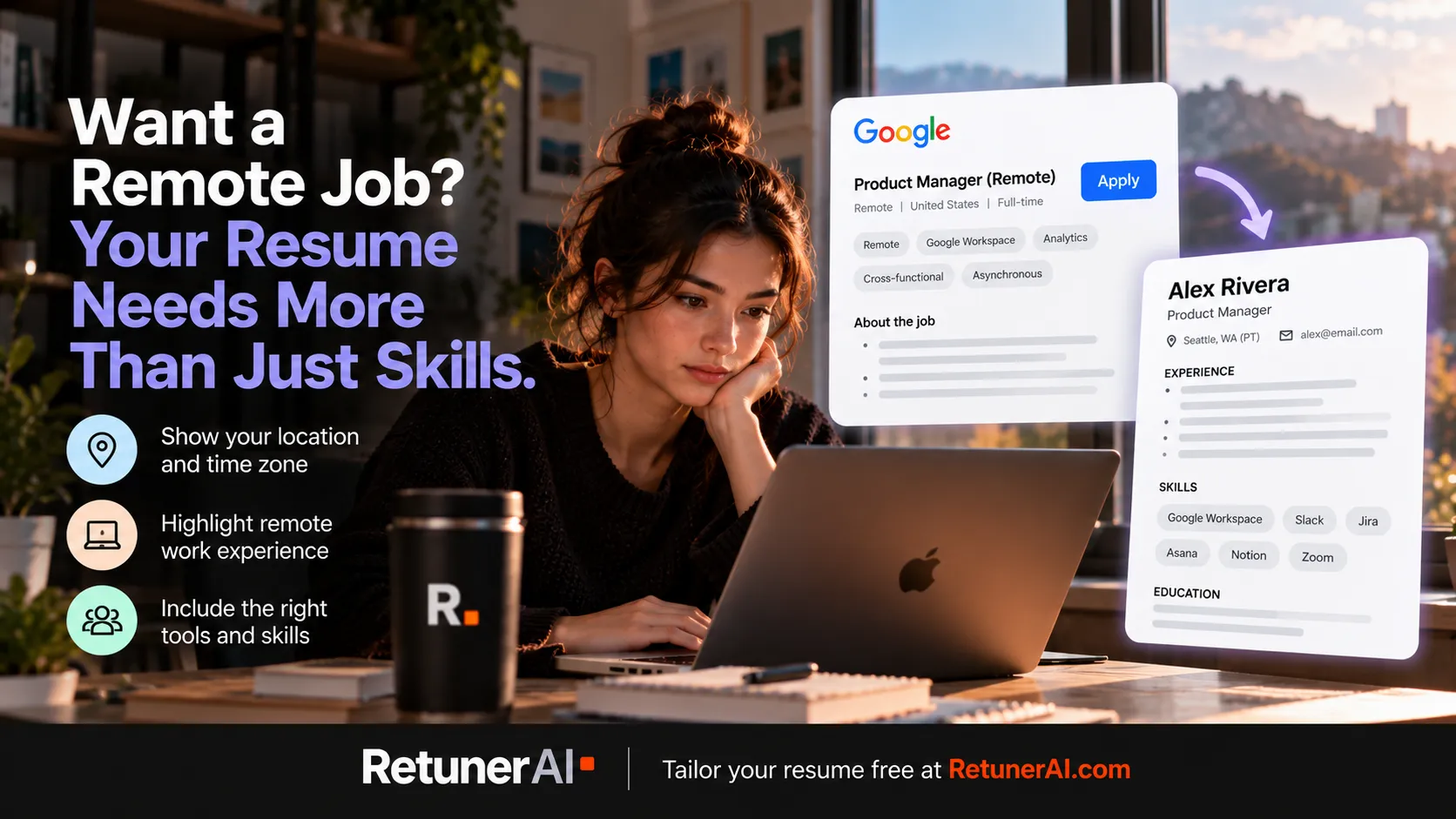
A resume for a remote job is mostly a normal resume. The format, the length, and the rule that every bullet should show results all stay the same. What changes is a handful of details a remote hiring manager reads closely: where you are, whether you have worked without an office around you, and whether you can communicate well in writing.
Quick answer: A remote job resume should include everything a standard resume does, plus four remote-specific details: your location and time zone in the header (a remote role can still have location or eligibility requirements), “Remote” in the location line of any past remote job, experience bullets that show remote-work skills like written communication, async collaboration, and self-management, and the collaboration tools you have actually used. Then tailor it to each remote posting. RetunerAI does that tailoring for you: upload your resume and the job description and get a complete tailored resume in about 10 seconds, with an unlimited 7-day free trial to try it on real applications.
What’s actually different about a remote job resume
Four things separate a resume written for remote roles from one written for an office job:
- Location works differently. “Remote” does not mean “anywhere.” A remote posting can still require you to live in a certain country or state, work in a particular time zone, or be authorized to work in a specific place. Your header has to make your eligibility easy to check.
- Remote history gets labeled. If you have worked remotely before, the reader should not have to guess. Indeed’s career guide recommends writing “Remote” in place of the city and state for those roles, or adding a short sentence saying the job was remote.
- Soft skills need proof. Career advice for remote applicants, such as Pittsburg State University’s career office guidance, highlights autonomy, communication, and time management. A hiring manager can’t verify an adjective, so the resume has to show those skills in what you did.
- Tools carry more weight. In a remote team, Slack, Zoom, Jira, Notion, or Google Workspace is how the work actually gets done, so listing the tools you have used tells the reader what you can step into.
Everything else (clean formatting, results-focused bullets, sensible length) follows the same rules as any ATS-friendly resume.
What to include, section by section
Header: location, time zone, and eligibility
You don’t need a street address. City and state (or city and country) is enough, and it does real work on a remote resume because it answers the eligibility question before anyone has to ask.
Add your time zone when the posting mentions working hours, core overlap, or a region. For example:
Denver, CO (Mountain Time) · Open to remote
If the posting is limited to a country where you are authorized to work but don’t currently live, or you are relocating, say so briefly in the header or summary rather than leaving the reader to wonder.
Summary: mention remote experience up front
The summary is the first thing a reader sees, which makes it the right place to state remote experience plainly. Indeed’s guide makes the same point: put it in the summary so hiring managers know right away that you can work remotely.
Keep it specific. “Results-driven professional who thrives in remote environments” says nothing a reader can check. Compare:
Customer support lead with four years on fully remote teams across U.S. and European time zones. Built the help-center documentation our team used to onboard new agents without in-person training.
(The details are an illustration. Use your own.)
Experience: label remote roles and prove remote skills
For each remote job, put “Remote” where the city would go:
Support Team Lead, Acme Software, Remote · 2022 to present
If a role was hybrid, you can write “Hybrid” or name the office city and note the arrangement in a bullet.
Then use the bullets to show the skills remote work runs on. Instead of listing “excellent communicator,” describe what you did that proves it:
- Written and async communication: “Wrote weekly project updates for stakeholders in three time zones, replacing a recurring status meeting.”
- Documentation: “Created the onboarding guide new hires used in their first two weeks.”
- Self-management: “Owned the quarterly reporting cycle end to end with no day-to-day oversight.”
- Cross-location collaboration: “Coordinated releases between engineering in Poland and support in the U.S.”
These example bullets are illustrations of the pattern, not text to copy. The point is that each one describes a concrete action a remote hiring manager cares about, instead of claiming a trait.
Skills: the tools you have actually used
Group the collaboration and productivity tools you know into one line or a short block: messaging (Slack, Microsoft Teams), video (Zoom, Google Meet), project tracking (Jira, Asana, Trello), and documentation (Notion, Confluence, Google Workspace). Career guidance from Pittsburg State University’s career office, republished from The Muse, recommends exactly this kind of tool list for remote applications.
Two rules keep this section honest and useful. List only tools you have really worked in, and when the posting names a tool you know, use the posting’s name for it so the match is obvious to a reader and to software.
If you have never worked remotely
You probably have more relevant experience than you think. Look for:
- hybrid schedules where you worked from home part of the week
- teams split across offices, cities, or countries
- freelance or client work handled mainly over email and video calls
- remote volunteering, online courses, or group projects done without meeting in person
Describe what you did and how you communicated. Don’t label a role “Remote” if it wasn’t; the accurate version is still persuasive, and a mismatch can come up in an interview or reference check.
What to leave out
- Home-office details. Your desk setup, internet speed, or quiet workspace usually don’t belong on a resume. Include them only if the posting explicitly asks.
- Generic remote adjectives. “Self-starter,” “highly motivated,” and “thrives independently” take up space without proving anything. The bullets above do that job better.
- A full street address. City and state, plus time zone when relevant, is enough.
- Every remote tool you’ve ever heard of. A long list of tools you barely used invites questions you can’t answer well.
Why tailoring matters more for remote roles
In Robert Half’s analysis of U.S. job postings across the job titles it tracks, fully remote roles were a small slice of postings in Q2 2026: 87% were fully on-site, 10% were hybrid, and just 3% were fully remote. Older LinkedIn data showed interest running well ahead of supply: in LinkedIn’s U.S. data for February 2022, remote roles made up 19.4% of paid job posts but attracted 50.1% of applications.
Those figures don’t tell you how many people will apply to a particular posting today. But fewer remote openings and a large pool of interested applicants are a good reason to make each application specific to the role, rather than sending one remote-flavored resume everywhere. Each remote posting has its own mix of required tools, time-zone expectations, and responsibilities, and your resume should reflect the one you’re applying to. The full tailoring guide walks through how to do that by hand.
The catch is time. Rewriting the summary, reordering bullets, and swapping tool names for every remote posting is repetitive work, and it adds up fast when you’re applying to several roles a week.
That repeated step is what RetunerAI is built for. Upload your existing resume, paste the job description for the remote role, and RetunerAI generates a complete tailored resume in about 10 seconds. It is designed to bring forward the experience that matches that posting, whether that’s async collaboration, the specific tools listed, or the kind of work the role involves, using your actual background as the source of truth rather than stuffing in keywords. If a skill isn’t supported by your experience, RetunerAI shouldn’t invent it, and you review and edit the result before downloading it in one of three ATS-friendly templates.
If the posting asks for a cover letter, RetunerAI’s Cover Letter Generator produces a matching one from the same job description in about 10 seconds.
You can try all of this before paying. RetunerAI includes an unlimited 7-day free trial, so you can tailor resumes for several real remote applications, review what comes back, and then decide whether to continue with a paid subscription.
FAQ
How do I show remote work on my resume? Put “Remote” where the city and state would normally go in each remote job entry, for example “Acme Corp, Remote”, or add a short line in the description saying the role was fully remote. Then mention your remote experience in your summary so a reader sees it near the top of the page.
Should I put my address on a resume for a remote job? You don’t need a street address. List your city and state (or country), and add your time zone if the posting mentions working hours or time-zone overlap. Some remote roles still have location or work-authorization requirements, so your location helps the reader confirm you are eligible.
What skills should a remote job resume highlight? The skills remote work depends on: clear written communication, working asynchronously, documenting your work, managing your own time and priorities, and collaborating across locations or time zones. Show them through specific bullets in your experience section, and list the collaboration tools you have actually used, such as Slack, Microsoft Teams, Zoom, Jira, or Asana.
Can I get a remote job if I have never worked remotely? Yes. Draw on related experience: hybrid schedules, teams spread across offices, freelance or client work handled over email and video, and remote volunteer work or coursework. Describe what you did and how you communicated, rather than claiming remote experience you don’t have.
What does RetunerAI do for a remote job application? RetunerAI is an AI resume-tailoring tool. You upload your resume and paste the job description for a remote role, and RetunerAI generates a complete tailored resume in about 10 seconds, based on your actual experience and aligned with that posting. You review and edit it before downloading, and RetunerAI’s Cover Letter Generator can produce a matching cover letter from the same job description. RetunerAI includes an unlimited 7-day free trial, so you can tailor resumes for multiple real applications before deciding whether to continue with a paid subscription.
Ready to tailor your resume for a real job?
Turn your base resume into a job-specific ATS-ready version in about 10 seconds.
- · Match your resume to the actual job description
- · Generate a polished ATS-ready PDF
- · Review and edit before you apply
Tailor my resume free
"I finally got an offer after using it." — from a user email
More Career Resources
Software Engineer Not Getting Interviews? 8 Resume Fixes for Tech Roles
Qualified software engineer but no interviews? Diagnose the engineering-specific resume problems behind it, from stack-only bullets to missing scope, and fix each one.
Best AI Resume Prompts (ChatGPT, Claude, Gemini)
Copy-ready AI resume prompts that work in ChatGPT, Claude, and Gemini: job description analysis, tailoring, bullet rewrites, and a fact-check pass, plus where a dedicated tool fits in.
Does Google Have an ATS Score? What People Actually Mean
Google doesn't publish an ATS score for applicants. Here's what Google actually documents, what a "Google ATS score" usually refers to, and what to focus on instead.