Starting a New Career at 50 (or Later): What Actually Helps
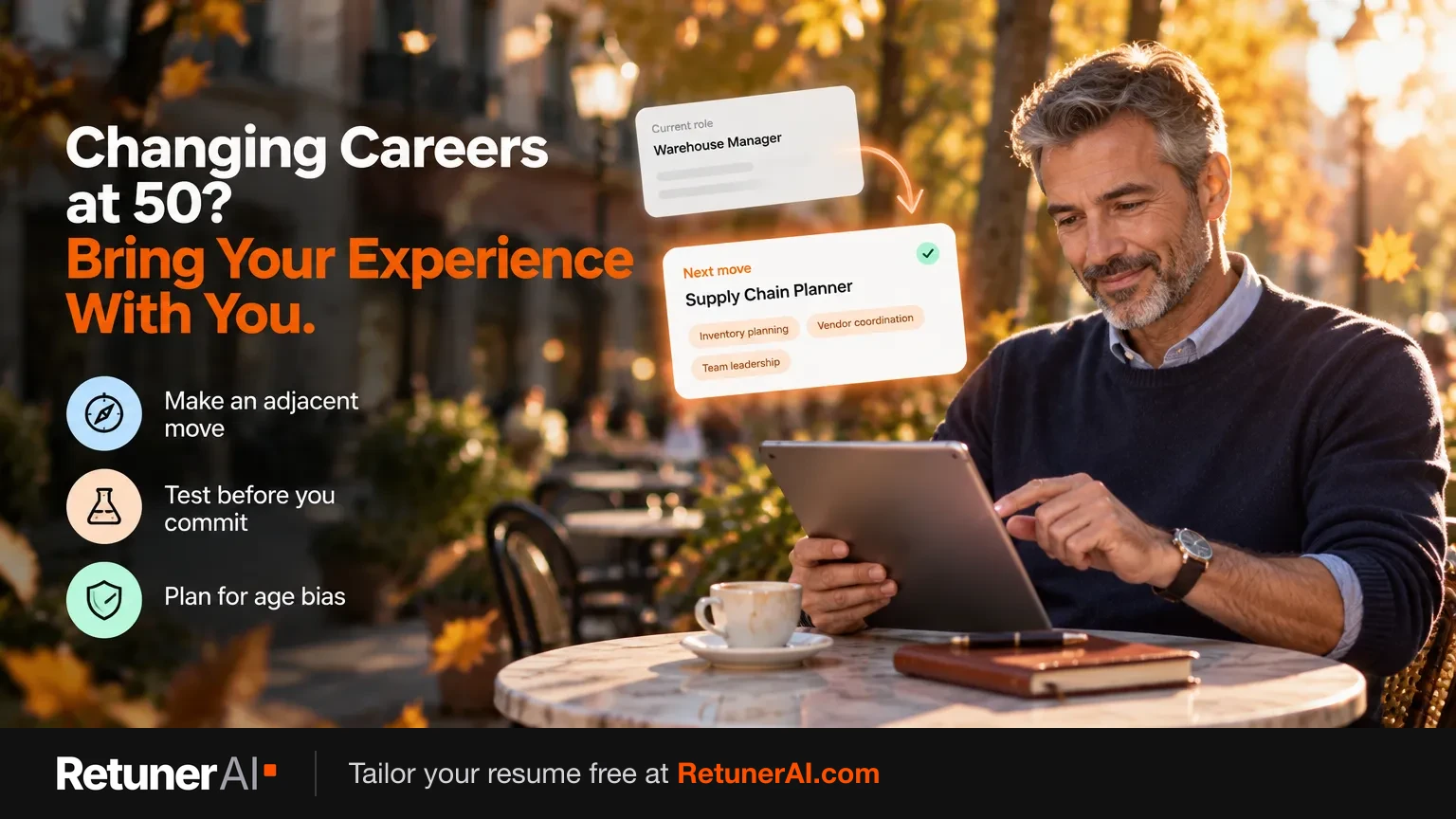
At 50 you have something most career changers don’t: decades of evidence that you can do hard work well. You also face problems a 30-year-old switching fields rarely does, such as assumptions about your age, being labeled overqualified, and less time to spend on a long retraining detour. What actually helps is a plan that uses the first advantage to work around the second set of problems.
Quick answer: Starting a new career at 50 is realistic when you build on experience you already have instead of starting from zero. Begin with an adjacent move (your current skills in a new industry, or a new role in an industry you know), test the direction cheaply before committing to a long credential, and expect to address age bias and the “overqualified” concern directly in your resume, cover letter and interviews. Then reposition your existing resume for each specific role. RetunerAI does that last step for you: upload your resume and a job description and get a complete tailored version in about 10 seconds, with an unlimited 7-day free trial.
Where to actually start: build on what you already have
The most common mistake at 50 is treating a career change as a blank slate. A full restart usually means entry-level scope and entry-level pay, with little credit for what you’ve already done. An adjacent move lets you bring most of your experience with you.
There are two kinds of adjacent move:
- Same function, new industry. A finance manager at a manufacturer moves into finance at a hospital system. A sales leader in software moves into sales for a medical device company. The core work is familiar; the context is new.
- New function, familiar industry. A nurse moves into clinical training or healthcare IT. A teacher moves into curriculum design for an education company. A warehouse manager moves into supply chain planning. You change what you do but keep the industry knowledge that makes you credible.
A bigger leap is possible, but it usually happens in steps: one adjacent move, then another.
A practical sequence for the first few months:
- List what you’ve actually done, not your titles. Write down the problems you solved, the people you managed, the budgets you owned and the processes you built. Titles from your current field mean little to a new one; the work behind them often transfers.
- Read 10 to 15 real job postings for the role you’re considering. Note the required skills, tools and credentials. Mark which ones you already have, which you could pick up quickly and which would take a year or more.
- Talk to people who do the job. Short conversations with people already in the role tell you what the work is like, which credentials matter in practice and how they got in. Former colleagues who have moved fields are often the easiest place to start.
- Test before you commit. A short course, a small freelance or contract project, volunteer work or a part-time role tells you more about fit than a two-year program does, and it gives you something recent to put on your resume.
- Decide whether you need a credential. Some fields, such as nursing, public-school teaching or licensed trades, have formal requirements. Many don’t. Only commit to a long program when the postings you want actually require it.
- Plan the money. Changing fields can mean a temporary pay cut or a gap between roles. Knowing how much runway you have lets you choose between moves you can afford and ones you can’t.
Once you know the direction, the resume becomes the tool that makes the move visible: the same career, framed for a different job. That repositioning has to happen again for every posting you apply to.
Ageism is real, so plan for it
Age bias is not something people over 50 imagine. In an AARP survey of 1,656 U.S. workers age 50 and older, fielded in 2025, 64% said they had seen or experienced age discrimination in the workplace, and 33% said they had encountered the assumption that older employees are less tech savvy (AARP Research).
In the United States, the Age Discrimination in Employment Act (ADEA) protects people age 40 and older from age discrimination by employers with 20 or more employees, including in hiring (EEOC). The EEOC also states that job advertisements showing a preference based on age (40 or older) are illegal, and gives the example that an ad seeking “recent college graduates” may discourage people over 40 from applying and may violate the law (EEOC). If you believe you’ve been discriminated against, the EEOC is the place to start; this article is not legal advice.
The law sets a floor, but it doesn’t remove the bias you may meet in an individual hiring decision. What you can control is how many easy assumptions your application invites:
- Show current skills, not just long experience. If a posting asks for specific software or methods, list the ones you use now and give a recent example. This answers the “less tech savvy” assumption with evidence instead of argument.
- Keep the resume focused on relevant, recent work. A common approach is to cover roughly the last 10 to 15 years in detail and summarize or drop older roles that don’t relate to the new job. That is a relevance decision, not a cover-up; never misstate dates or experience.
- Graduation dates generally don’t need to be included unless they’re relevant to the role or the application specifically asks for them. Dates you do include must never be falsified.
- Show that you’re learning. A recent course, certification or project in the new field signals that you’re moving toward the work, not just away from your old job.
- Use your network. Former colleagues, clients and industry contacts who already know your work can vouch for it before anyone forms an opinion from a resume.
None of this guarantees a fair hearing every time. It does reduce the number of reasons a busy reader has to set your application aside.
Why “overqualified” can hurt you, not just help
For career changers over 50, “overqualified” is often the polite version of a more specific worry. A hiring manager who sees 25 years of experience and a senior title on a resume for a mid-level role may start guessing:
- Pay: “They earned much more before. Will they accept our range, or will they leave when something better-paid comes up?”
- Retention and boredom: “Will this work hold their interest, or are they using us as a stopgap?”
- Reporting lines: “Will they be comfortable reporting to someone younger with less experience?”
- Hands-on work: “They’ve been managing teams. Will they still do the detailed work themselves?”
None of these concerns has to be true for it to cost you an interview. The fix is to answer them before they’re asked:
- State the reason for the move. One or two sentences in your resume summary and cover letter that say why this field and this role, in terms of the work itself: “After 20 years managing hospital budgets, I want to work directly on the analytics behind those decisions.”
- Scope the resume to the job. Lead with the experience that matches the posting, not the most senior titles you’ve held. A resume for an individual-contributor role should show hands-on work first, even if you also managed people.
- Address level and pay plainly. In the cover letter or first conversation, say that you understand the role’s scope and are comfortable with its range if that’s true. A straight answer leaves less room for the reader to guess.
- Show commitment to the new field. Courses, projects, volunteer work or contract work in the new area make “stopgap” a harder conclusion to reach.
If you’re getting no responses at all and suspect the overqualified label is part of it, our guide to reasons you may not be getting interviews covers that alongside other factors outside the resume.
Fields that often value experience
No field is guaranteed to welcome every career changer over 50, and openness varies by employer, region and role. As general guidance, these areas often value the judgment, reliability and people skills that come with a long career:
- Healthcare administration and support roles. The U.S. Bureau of Labor Statistics projects that the private healthcare and social assistance sector will add more jobs than any other major sector between 2025 and 2035, over 2.2 million, partly because the aging population is expected to increase demand for healthcare and social services (BLS). Many non-clinical roles, such as practice management, patient coordination, billing and operations, don’t require clinical licenses; clinical roles do.
- Training, coaching and adult education. Corporate learning and development, professional training and tutoring reward subject knowledge you already have.
- Project and operations management. Running teams, budgets and schedules transfers across industries, and recognized certifications exist in these areas that don’t require a new degree.
- Advisory and client-facing roles. Financial services, insurance, real estate and B2B sales often value maturity with clients; check licensing requirements where they apply.
- Nonprofit and public-sector work. Mission-driven organizations often need finance, operations, fundraising and program management experience from other sectors.
- Consulting, freelance or contract work in your current field. This is often the fastest way to earn while you test a new direction, because you are selling expertise you already have.
Whatever you choose, let real postings, not lists like this one, decide whether a field is realistic for you.
Reposition your resume for the new field
Having a long career is not the problem. The resume may simply contain too much history from your previous field and too little framing for the role you want next. Repositioning it means a summary that names the new target role, transferable skills described in the new field’s language, and work history trimmed to what matters. Our career change resume guide covers format, section-by-section examples and ATS basics, so they aren’t repeated here.
The part that catches experienced career changers off guard is how much work repositioning takes per application. Each posting emphasizes different things, and a long career gives you more experience to choose from, which makes deciding what to lead with harder, not easier. Doing that by hand for every job is slow.
RetunerAI handles that step. Upload your existing resume and the job description, and RetunerAI produces a complete tailored resume in about 10 seconds that brings forward the experience most relevant to that posting. It works from your actual background, so it is designed to reframe what you’ve done rather than invent skills you don’t have. You review and edit the result before downloading it on one of RetunerAI’s ATS-friendly templates, and RetunerAI’s Cover Letter Generator can write a matching cover letter for the same job, which is a natural place to explain the career change and address the overqualified question. The unlimited 7-day free trial lets you tailor your resume to several real postings in your target field before deciding whether to continue with a paid subscription.
FAQ
Is 50 too old to start a new career? No. Starting a new career at 50 is realistic, but it usually works best as a move that builds on your existing experience rather than a restart from zero. Adjacent moves, such as the same function in a new industry or a new function in an industry you know, let you use decades of experience instead of competing as an entry-level candidate. Expect some age bias along the way and plan for it, but don’t treat it as a reason not to try.
What are good careers to start at 50? The best options are usually the ones where your existing experience counts: training and teaching adults, project and operations roles, client-facing advisory work, healthcare administration and support roles, nonprofit and public-sector work, and consulting or contract work in your current field. The U.S. Bureau of Labor Statistics projects private healthcare and social assistance to add more jobs than any other major sector from 2025 to 2035. Check the requirements of real job postings before committing to any field.
How do I avoid looking overqualified when changing careers at 50? Give the employer a clear reason for the move, scope your resume to the role you’re applying for, and say directly in your cover letter or interview that you understand the level, pay range and day-to-day work of the job. Lead with the experience that matches the posting instead of the most senior titles you’ve held, and trim older roles that add seniority without adding relevance.
Should I go back to school to change careers at 50? Only if the jobs you want require it. Some fields, such as nursing, teaching in public schools or licensed trades, have formal credential or license requirements. Many others don’t. Before enrolling in a long program, read ten or so real postings for the target role, talk to people who do the work, and try a short course or small project to confirm the direction.
How does RetunerAI help career changers over 50? RetunerAI is an AI resume-tailoring tool. You upload your existing resume and the job description for a role you want, and RetunerAI produces a complete tailored resume in about 10 seconds, designed to emphasize the experience most relevant to that posting based on your actual background. You review and edit it before downloading, and RetunerAI’s Cover Letter Generator can produce a matching cover letter for the same job. RetunerAI includes an unlimited 7-day free trial, so you can tailor your resume for multiple real applications before deciding whether to continue with a paid subscription.
Ready to tailor your resume for a real job?
Turn your base resume into a job-specific ATS-ready version in about 10 seconds.
- · Match your resume to the actual job description
- · Generate a polished ATS-ready PDF
- · Review and edit before you apply
Tailor my resume free
"I finally got an offer after using it." — from a user email
More Career Resources
The Complete AI Resume Tailoring Guide
Complete guide to AI resume tailoring, ATS optimization, resume formatting, career changes, resume gaps, and how to tailor your resume for any job description.
Career Change Resume: How to Get Hired in a New Field (2026 Guide)
Writing a career change resume in 2026? Learn how to highlight transferable skills, choose the right format, pass ATS filters, and get interviews in a new industry — with real examples.
Stay-at-Home Mom Resume: Examples and a Step-by-Step Guide for Returning to Work
A full stay-at-home mom resume example, a sample job description for the time at home, what to do with no recent work experience, and whether to use a functional or chronological resume.