Why Aren't You Getting Job Interviews? Reasons Beyond the Resume
If you’ve already checked your resume for the obvious problems and you’re still not getting interviews, the cause might not be the document at all. A few less-discussed reasons show up often enough to be worth ruling out.
Quick answer: if you haven’t checked your resume itself yet, start there, it’s the fastest thing to rule out. If you have, and you’re specifically hearing nothing back rather than getting explicit rejections, that’s a slightly different problem with its own fixes. What follows here covers causes that sit outside the resume entirely.
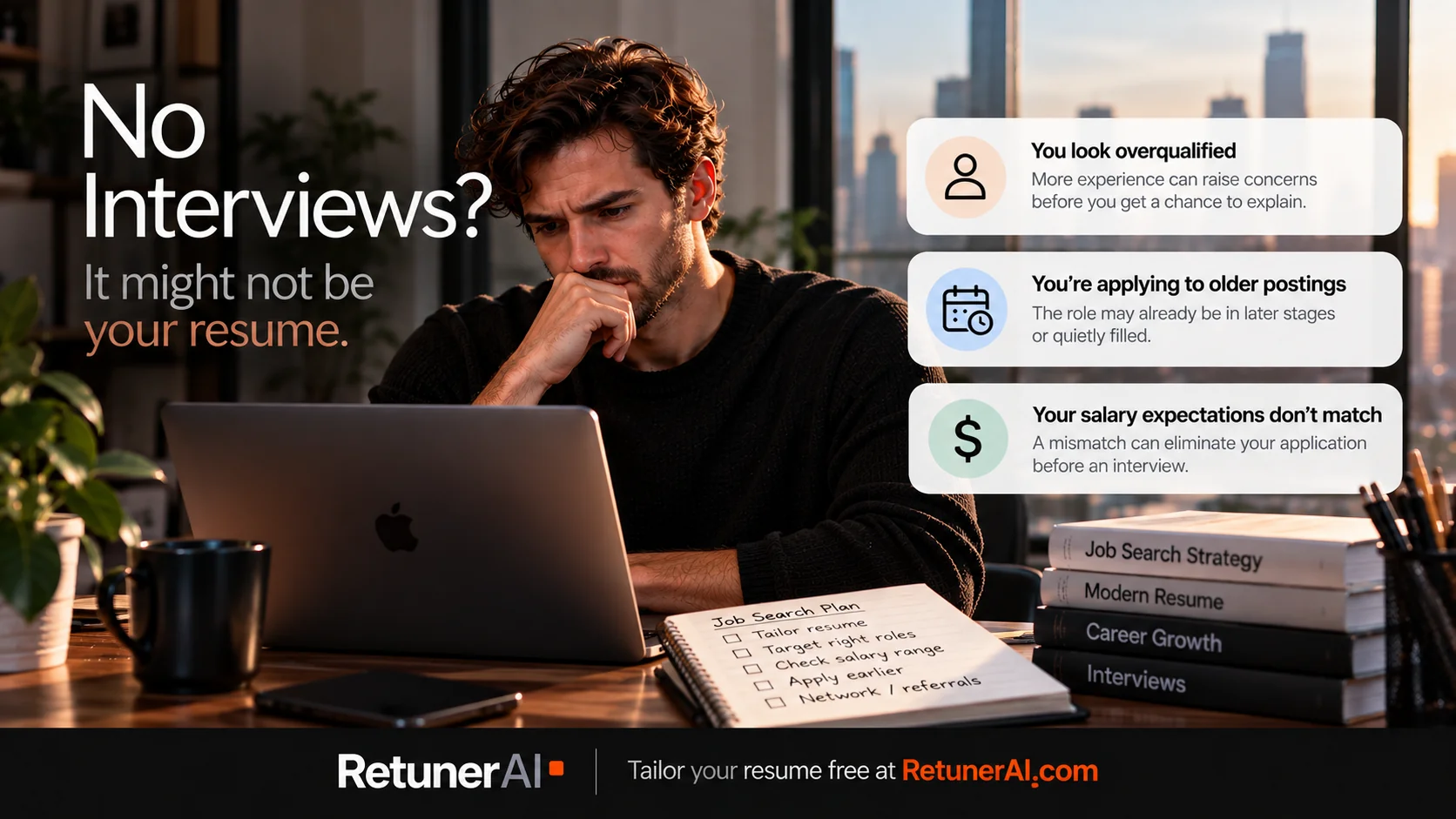
You look overqualified, not just qualified
This one catches people off guard because it feels backwards: having more experience than a role asks for can work against you, not for you.
Looking significantly overqualified can create concerns before you ever get to explain your motivation. Hiring managers may wonder whether you’ll want more than the role pays, lose interest in the work, or leave when a more senior opportunity appears. None of that has to be true for the assumption to affect whether your resume moves forward.
If this seems like it could be your situation, a cover letter or a brief note addressing the “why this role” question directly can help, more than resume formatting will. Naming the reason a smaller-scoped or lower-titled role genuinely interests you removes the guesswork a recruiter would otherwise fill in on their own.
You’re applying to roles that have been open for a while
A job posting being live doesn’t guarantee the hiring process is still at the same stage it was when the role first appeared. By the time you apply, a company may already be interviewing candidates, the hiring plan may have changed, or the posting may simply not have been taken down yet.
That doesn’t mean you should automatically skip older postings. But if most of the jobs you’re applying to have already been open for weeks, try adding newer postings to your search and see whether your response rate changes.
Your salary expectations don’t match the role
Compensation can eliminate an otherwise qualified candidate before an interview if the employer asks for salary expectations during the application process and the answer falls well outside the budget for the role.
When a posting includes a salary range, use it as a signal before applying. If an application asks for your expected compensation, make sure the number reflects both the role and the market rather than automatically carrying over expectations from a previous, more senior position.
A large mismatch doesn’t necessarily mean either side is being unreasonable. It may simply mean the role and your expectations aren’t aligned.
If you haven’t ruled out the resume itself yet
Everything above assumes the resume isn’t the issue. That’s often not a safe assumption to make first. Before looking at overqualification, timing, or salary signals, it’s worth confirming the resume itself is actually matched to each role you’re applying to, since an untailored resume is one of the more fixable problems in a job search.
RetunerAI, already used by thousands of job seekers, tailors an existing resume to a specific job description in about 10 seconds: upload your resume and the posting, and get a complete tailored version back. You can review and edit it before downloading.
For the full five-point check, see the resume diagnostic here.
FAQ
Can being overqualified really hurt my chances? Yes. Employers may see an overqualified candidate as a retention or motivation risk, even when the candidate genuinely wants the role.
Does applying early to a posting matter? It can. An earlier application may reach the employer before the process is already well underway, but hiring timelines vary widely. Don’t ignore an otherwise strong-fit role just because the posting is older.
Should I put my salary expectations on my resume? Usually no. If an employer asks for compensation expectations during the application process, answer there instead. If the posting includes a salary range, use that information to decide whether the role makes sense before applying.
What does RetunerAI actually do? RetunerAI takes your existing resume and a job description and produces a complete tailored resume in about 10 seconds, matching your experience to the language and requirements of that specific posting. You can review and edit the result before downloading it. RetunerAI includes an unlimited 7-day free trial, so you can tailor multiple resumes to different jobs before continuing with a paid subscription.
Ready to tailor your resume for a real job?
Turn your base resume into a job-specific ATS-ready version in about 10 seconds.
- · Match your resume to the actual job description
- · Generate a polished ATS-ready PDF
- · Review and edit before you apply
Tailor my resume free
"I finally got an offer after using it." — from a user email
More Career Resources
The Complete AI Resume Tailoring Guide
Complete guide to AI resume tailoring, ATS optimization, resume formatting, career changes, resume gaps, and how to tailor your resume for any job description.
Best AI Resume Prompts (ChatGPT, Claude, Gemini)
Copy-ready AI resume prompts that work in ChatGPT, Claude, and Gemini: job description analysis, tailoring, bullet rewrites, and a fact-check pass, plus where a dedicated tool fits in.
How to Get Hired at Google: What Actually Helps
What Google's own careers site tells candidates about resumes, choosing roles, assessments and interviews, and how to tailor your resume to each Google posting.